X - X 2y - 3x 6y

penangjazz
Dec 04, 2025 · 9 min read
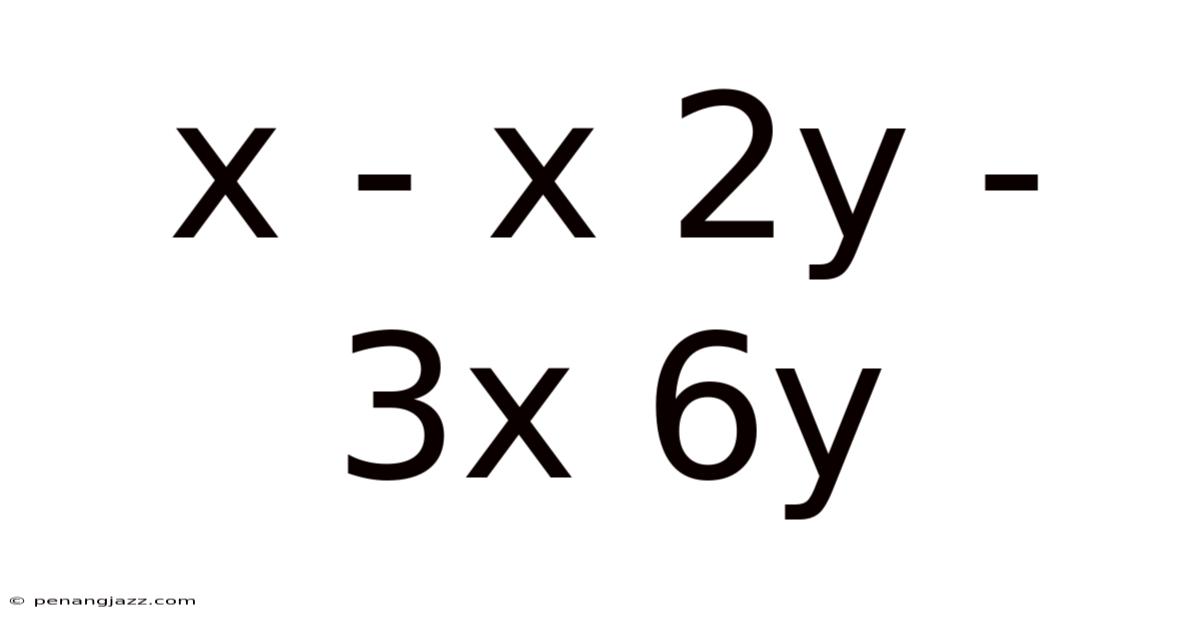
Table of Contents
Decoding the Expression: x - x²y - 3x + 6y
The algebraic expression x - x²y - 3x + 6y, at first glance, might seem like a jumble of variables and coefficients. However, by understanding the fundamental principles of algebra, we can simplify, factorize, and ultimately unlock its underlying structure. This article will provide a comprehensive guide to working with this expression, breaking down each step with clarity and precision.
Understanding the Components
Before diving into manipulations, let's identify the core components of the expression:
- Terms: The expression consists of four distinct terms: x, -x²y, -3x, and 6y. A term is a single number or variable, or numbers and variables multiplied together.
- Variables: The variables involved are 'x' and 'y'. These represent unknown quantities that can take on different values.
- Coefficients: Coefficients are the numerical values multiplying the variables. In this expression, we have:
- The coefficient of 'x' in the first term is 1 (implied).
- The coefficient of 'x²y' is -1.
- The coefficient of 'x' in the third term is -3.
- The coefficient of 'y' is 6.
- Degree: The degree of a term is the sum of the exponents of its variables.
- The degree of 'x' is 1.
- The degree of '-x²y' is 3 (2 for x + 1 for y).
- The degree of '-3x' is 1.
- The degree of '6y' is 1.
Simplifying the Expression
The first step towards understanding the expression is to simplify it by combining like terms. Like terms are terms that have the same variables raised to the same powers. In our expression, 'x' and '-3x' are like terms.
- Identify Like Terms: We have 'x' and '-3x' as like terms.
- Combine Like Terms: x - 3x = -2x
Therefore, the simplified expression becomes:
-2x - x²y + 6y
This simplified form is easier to work with and provides a clearer representation of the expression.
Factoring the Expression
Factoring involves expressing the expression as a product of simpler expressions. This is the reverse process of expanding (multiplying out) expressions. There isn't one single "right" way to factor an expression; the approach depends on the structure of the expression itself. In this case, we can use a technique called factoring by grouping.
-
Rearrange Terms (Optional but Helpful): Rearranging the terms can make grouping easier to visualize. Let's rearrange our simplified expression:
-x²y + 6y - 2x
-
Group Terms: We'll group the first two terms and look for a common factor:
(-x²y + 6y) - 2x
-
Factor out the Greatest Common Factor (GCF) from each group:
-
In the first group (-x²y + 6y), the GCF is 'y'. Factoring out 'y' gives us:
y(-x² + 6)
Now our expression looks like this:
y(-x² + 6) - 2x
Unfortunately, this approach doesn't immediately lead to a complete factorization of the entire expression. While we successfully factored the first two terms, the remaining term, '-2x', doesn't share a common factor with the factored group.
-
-
Trying a Different Grouping: Let's go back to the simplified expression: -2x - x²y + 6y and rearrange it differently. This time, let's group the terms like this:
(-2x + 6y) + (-x²y)
Factor out a -2 from the first group:
-2(x - 3y) - x²y
Again, this grouping doesn't lead to a simple, complete factorization. The term -x²y doesn't share a common factor with (x - 3y).
-
Revisiting the Original Expression: Sometimes, going back to the original expression can reveal a better approach. Let's consider:
x - x²y - 3x + 6y
Simplify:
-2x - x²y + 6y
Rearrange:
- x²y + 6y - 2x
Group the first two terms:
(-x²y + 6y) - 2x
Factor out 'y' from the first group:
y(-x² + 6) - 2x
This approach, as we saw before, doesn't lead to a complete factorization.
-
Trying another Grouping with the original expression: Let's group the first and third terms, and the second and fourth terms:
(x - 3x) + (-x²y + 6y)
Simplify the first group and factor out 'y' from the second group:
-2x + y(-x² + 6)
This also doesn't lead to further simplification.
Conclusion on Factoring:
In this specific case, the expression x - x²y - 3x + 6y does not easily factor into a simple product of polynomials with integer coefficients. We've tried various grouping methods, but none result in a common factor across all terms.
It's important to recognize that not all algebraic expressions can be factored neatly. This expression might be better analyzed using other techniques, or it might simply remain in its simplified form.
Exploring Other Manipulations and Interpretations
While a clean factorization might not be possible, we can explore other manipulations and consider how the expression might be interpreted in different contexts.
-
Completing the Square (Partial): Completing the square is a technique used to rewrite quadratic expressions in a specific form. While our expression isn't purely quadratic, we can attempt to apply this technique partially with respect to 'x'. First, let's rewrite the simplified expression, focusing on the 'x' terms:
-x²y - 2x + 6y
Factor out a '-y' from the first two terms:
-y(x² + (2/y)x) + 6y
To complete the square inside the parentheses, we need to add and subtract (b/2)², where 'b' is the coefficient of the 'x' term (which is 2/y in this case). So (b/2)² = (1/y)².
-y(x² + (2/y)x + (1/y)² - (1/y)²) + 6y
Now we can rewrite the expression inside the parentheses as a squared term:
-y((x + 1/y)² - (1/y)²) + 6y
Distribute the '-y':
-y(x + 1/y)² + y(1/y)² + 6y
Simplify:
-y(x + 1/y)² + 1/y + 6y
Combine the last two terms:
-y(x + 1/y)² + (1 + 6y²)/y
This form expresses the original expression as a squared term involving 'x', plus a term that depends only on 'y'. While this might not be the most intuitive simplification, it highlights the dependence of the expression on both 'x' and 'y'.
-
Analyzing as a Function: We can consider the expression as a function of two variables, f(x, y) = x - x²y - 3x + 6y. This allows us to explore its behavior for different values of 'x' and 'y'.
-
Partial Derivatives: We can calculate the partial derivatives with respect to 'x' and 'y' to understand how the function changes as each variable changes.
- ∂f/∂x = 1 - 2xy - 3 = -2 - 2xy
- ∂f/∂y = -x² + 6
These partial derivatives tell us the instantaneous rate of change of the function in the x and y directions, respectively.
-
Critical Points: We can find critical points by setting both partial derivatives equal to zero and solving for 'x' and 'y'.
- -2 - 2xy = 0 => xy = -1 => y = -1/x
- -x² + 6 = 0 => x² = 6 => x = ±√6
If x = √6, then y = -1/√6 = -√6/6
If x = -√6, then y = -1/-√6 = 1/√6 = √6/6
So, we have two critical points: (√6, -√6/6) and (-√6, √6/6). These points could correspond to local maxima, local minima, or saddle points of the function. Further analysis (using the second derivative test) would be needed to classify these critical points.
-
-
Graphical Representation: Since it's a function of two variables, we can visualize the expression as a surface in 3D space. The z-coordinate would represent the value of the expression for given values of 'x' and 'y'. Graphing tools can be used to visualize the shape of this surface and gain further insights into the function's behavior.
Practical Applications and Interpretations
While the expression itself might seem abstract, similar algebraic forms appear in various mathematical and scientific contexts.
-
Modeling Relationships: Such expressions can be used to model relationships between variables in fields like physics, economics, or engineering. For example, 'x' might represent a quantity of a product, and 'y' might represent its price. The expression could then model a profit function, taking into account production costs and revenue.
-
Approximation Techniques: In numerical analysis, polynomial expressions are often used to approximate more complex functions. By carefully choosing the coefficients, we can create a polynomial that closely matches the behavior of a more complicated function over a specific range of values.
-
Control Systems: In control theory, algebraic expressions are used to describe the behavior of systems and design controllers to achieve desired performance. The variables might represent states of a system, and the expression might describe how these states evolve over time.
Common Mistakes and How to Avoid Them
Working with algebraic expressions requires careful attention to detail. Here are some common mistakes and how to avoid them:
-
Incorrectly Combining Like Terms: Ensure that you only combine terms that have the same variables raised to the same powers. For example, you cannot combine 'x' with 'x²' or 'xy'.
-
Sign Errors: Pay close attention to the signs of the coefficients. A simple sign error can completely change the result.
-
Incorrect Factoring: When factoring, double-check that the factored expression is equivalent to the original expression by multiplying it out.
-
Forgetting to Distribute: When multiplying a term by an expression in parentheses, make sure to distribute the term to all terms inside the parentheses.
-
Errors in Order of Operations: Always follow the order of operations (PEMDAS/BODMAS): Parentheses/Brackets, Exponents/Orders, Multiplication and Division (from left to right), Addition and Subtraction (from left to right).
FAQ
Q: Can all algebraic expressions be factored?
A: No, not all algebraic expressions can be factored into simpler expressions with integer or rational coefficients. Some expressions are prime, meaning they cannot be factored further.
Q: What is the purpose of factoring an expression?
A: Factoring can simplify expressions, make them easier to solve, and reveal underlying relationships between variables. It's useful in solving equations, simplifying rational expressions, and analyzing the behavior of functions.
Q: What are the different methods of factoring?
A: Common factoring methods include:
- Factoring out the Greatest Common Factor (GCF)
- Factoring by grouping
- Factoring quadratic expressions (e.g., using the quadratic formula)
- Using special factoring patterns (e.g., difference of squares, sum/difference of cubes)
Q: How do I know if I have factored an expression correctly?
A: Multiply the factored expression back out to see if it equals the original expression.
Q: What is the degree of an expression?
A: The degree of a term is the sum of the exponents of its variables. The degree of an expression is the highest degree of any of its terms.
Conclusion
The expression x - x²y - 3x + 6y, while not directly factorable in a straightforward manner, provides a valuable exercise in algebraic manipulation. By simplifying, exploring different factoring approaches, and considering interpretations as a function, we gain a deeper understanding of its properties and behavior. We've learned that not all expressions lend themselves to simple factorization and that other analytical techniques can provide further insights. The ability to manipulate and interpret algebraic expressions is a fundamental skill in mathematics and is essential for solving problems in various scientific and engineering disciplines. By understanding the underlying principles and avoiding common mistakes, you can confidently tackle more complex algebraic challenges.
Latest Posts
Latest Posts
-
What Is The Molecular Formula For Sodium Chloride
Dec 04, 2025
-
Can Atoms Be Created Or Destroyed
Dec 04, 2025
-
Molar Volume Of A Gas At Stp
Dec 04, 2025
-
How To Add Alcohol To Benzene
Dec 04, 2025
-
How To Get Rate Constant From Graph
Dec 04, 2025
Related Post
Thank you for visiting our website which covers about X - X 2y - 3x 6y . We hope the information provided has been useful to you. Feel free to contact us if you have any questions or need further assistance. See you next time and don't miss to bookmark.
